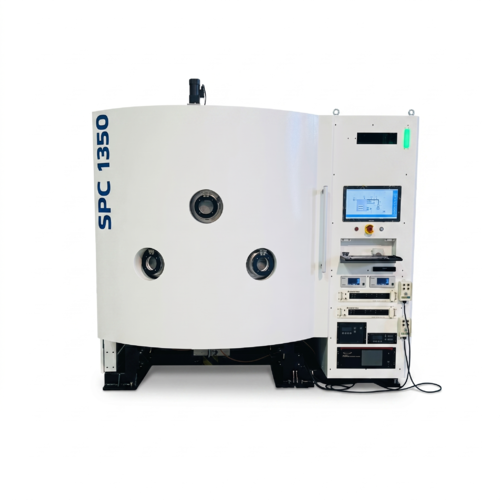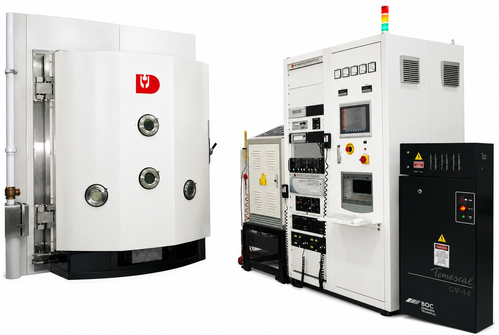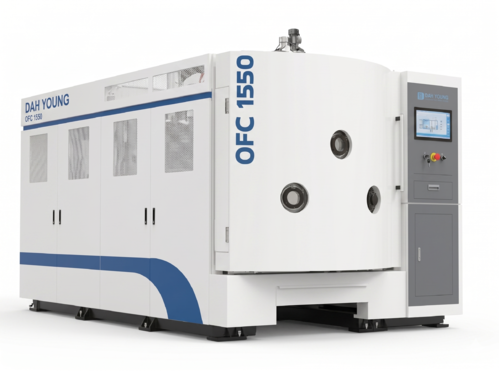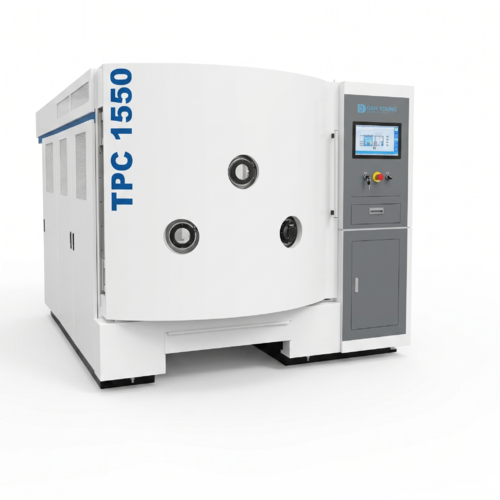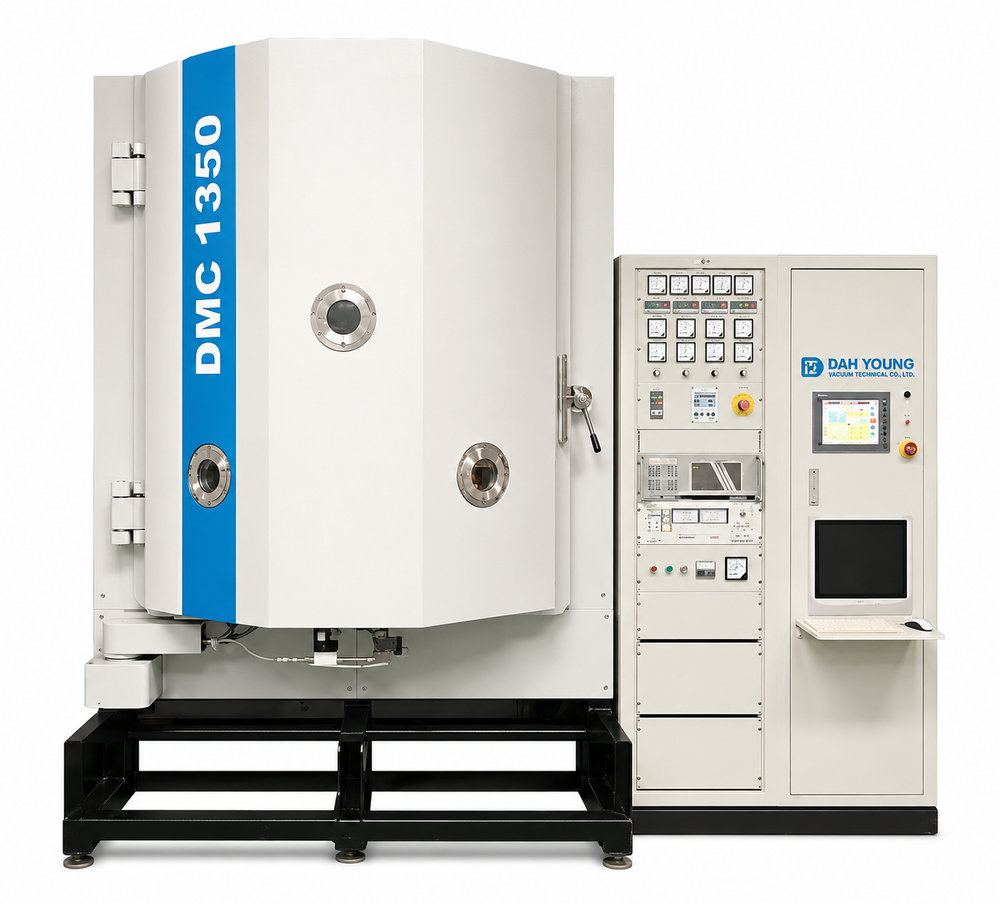
Plastic Lens Coater
PLC|Low-Temperature Evaporation Solution for Plastic Optical Lenses
Plastic Lens Coater | Low-Temperature Evaporation for Polymer OpticsA Low-Temperature Evaporation Platform Built for Plastic Optical Lenses
With the rapid growth of smartphone lenses, smart eyewear, and AR/VR optical modules, plastic optical lenses (Polymer Optics) have become indispensable components in today's optoelectronic industry. Compared with glass lenses, plastic lenses offer light weight, injection moldability, and design freedom — but they also present coating challenges: low substrate heat tolerance, surface stress sensitivity, and weaker adhesion.
The Dah Young Vacuum PLC (Plastic Lens Coater) is an evaporation system specifically optimized for optical resin substrates including PC, PMMA, CR-39, and Tritan. Through its low-temperature process design, stress-control fixtures, and Dah Young's proprietary IAD ion source low-temp optimization mode, the PLC deposits films with strong adhesion and high density without damaging the substrate — providing a stable, reliable, production-grade solution for high-growth markets including smartphone lenses, smart eyewear, and automotive optics.
Optimized Low-Temperature Process|Protecting Plastic Substrates from Deformation and Stress
The glass transition temperature (Tg) of plastic substrates typically falls between 100–150°C. Conventional high-temperature evaporation processes can easily cause thermal deformation, surface stress accumulation, and even degradation of optical properties. The PLC employs Dah Young's carefully optimized low-temperature process — keeping chamber process temperature below 80°C while leveraging the in-house ion source's low-temperature optimization mode to achieve excellent film density and adhesion without relying on high-temperature heating.
This low-temperature strategy not only protects the optical quality and mechanical integrity of plastic lenses, but also significantly shortens heating/cooling cycle time — substantially improving equipment utilization and production efficiency. For specialty resins highly sensitive to substrate temperature (such as CR-39 used in prescription eyewear), the PLC delivers industry-leading low-temperature coating capability.
Low-Stress IAD Process|High-Quality Optical Films on Plastic Substrates
Plastic substrates have low surface energy and varied polarity, making film adhesion a long-standing technical challenge in the industry. The PLC comes standard-equipped with Dah Young's in-house 18cm / 24cm / 27cm high-performance ion source, with ion energy parameters specifically optimized for plastic substrates — striking the optimal balance between ion bombardment intensity and substrate thermal load.
Through precisely controlled Low-Stress IAD, the PLC deposits high-density, low-stress optical films on plastic substrates. Film adhesion is significantly enhanced, passing cross-cut testing, abrasion testing, and high-temperature/humidity reliability validations — meeting the demanding environmental durability requirements of consumer electronics and automotive optics.
Proprietary OMS Optical Monitoring | Multilayer Precision Without Compromise
Common film systems on plastic optical lenses — blue-light cut, broadband anti-reflection (BBAR), color coatings — typically involve dozens of precisely stacked layers. The PLC comes standard-equipped with Dah Young's proprietary Optical Monitoring System (OMS), using real-time spectral detection to precisely control the deposition state of every layer, ensuring complex film stacks closely match design spectra.
OMS millisecond-level correction capability, combined with the FAST coating uniformity simulator, dramatically reduces tuning time for new plastic lens products — helping customers quickly transition from R&D to large-scale production.
SpecificationsPLC Series
| Item | PLC-1100 / 1350 / 1550 / 1800 |
|---|---|
| Product Line | Coater Series — Plastic Lens Coater |
| Substrate Material | Plastic optical substrates (PC, PMMA, CR-39, PEI, Tritan, various optical resins) |
| Coating Technology | E-beam Evaporation + Low-Temperature Ion-Assisted Deposition (IAD) |
| Ion Source | Dah Young in-house 18 / 24 / 27 cm high-performance ion source (low-temp mode optimized) |
| Optical Monitoring | Dah Young proprietary Optical Monitoring System (OMS) — real-time spectral detection |
| Process Temperature | ≦ 80°C (low-temp mode), preventing plastic substrate deformation and stress accumulation |
| Thickness Uniformity | Within ± 1.5% (full load) |
| Fixture Design | Planetary rotation fixture with low-stress clamping structure |
| Coating Materials | Oxides (SiO₂, TiO₂, Ta₂O₅, ZrO₂), Fluorides (MgF₂), Metals (Al, Ag, Cr), organosilicon hybrid films |
| Ultimate Vacuum | ≦ 5 × 10⁻⁶ Torr |
| Operation Mode | IPC fully automatic / manual mode |
| Optional Modules | PECVD hardcoat / plasma pre-treatment / customized fixture / specialty film stacks |
※ The above represents standard configuration. Actual specifications can be customized to customer application requirements.
01Optimized Low-Temperature Process | Protecting Plastic Substrate Optical Quality
- Low-Temperature Design: Chamber process temperature controllable below 80°C — effectively preventing thermal deformation and stress accumulation in plastic substrates.
- Shortened Thermal Cycles: Eliminates high-temperature heating phase, substantially reducing process cycle time and improving equipment utilization.
- Optical Property Preservation: Low-temperature processing ensures plastic lens refractive index, birefringence, and surface flatness are unaffected by the process.
02Dah Young In-house Ion Source | Low-Temperature Optimized IAD
- Low-Stress IAD: Ion energy parameters optimized for plastic substrates — strengthening film quality while minimizing film stress.
- High Adhesion: Passes cross-cut testing, abrasion testing, and high-temperature/humidity reliability validations.
- Dense Film Structure: Ion bombardment yields tightly packed film atoms — maintaining excellent film quality even under low-temperature conditions.
03Dah Young Proprietary Optical Monitoring System (OMS)
- Real-Time Spectral Detection: Spectral analysis technology precisely monitors deposition progress of every layer.
- High-Yield Assurance: Multilayer spectral film stacks on plastic lenses precisely meet design targets — substantially improving production yield.
04Dedicated Plastic Substrate Fixtures and Pre-treatment Integration
- Low-Stress Clamping: Planetary rotation fixtures combined with low-stress clamping structures prevent plastic substrate deformation under load.
- Plasma Pre-treatment: Optional plasma pre-treatment module effectively improves plastic surface energy, enhancing film adhesion.
- Customized Fixture Design: Custom fixtures designed for various lens curvatures, dimensions, and shapes — adapting to diverse injection-molded product designs.
05Complete Chamber Sizes | Built for Consumer Electronics Production Scale
- Comprehensive Lineup: Chamber sizes 1100 / 1350 / 1550 / 1800 covering R&D through volume production.
- High-Capacity Configuration: Larger chambers (1550/1800) meet the per-batch capacity demands of high-volume smartphone lens production.
- Flexible Investment: Choose models flexibly based on customer capacity planning — optimizing equipment investment ROI.
Combining low-temperature processing, low-stress IAD, and precision optical monitoring, the PLC delivers a stable, reliable, production-grade solution for plastic optical substrate coating — widely deployed across high-growth markets including consumer electronics, eyewear, and AR/VR.
01Consumer Electronics
Smartphone lenses, smart wearables, and tablet optical modules extensively use plastic lenses to achieve light weight and cost optimization. The PLC's low-temperature process perfectly protects plastic substrates while OMS monitoring ensures multilayer spectral precision — making it a key piece of equipment for smartphone lens production.
02Eyewear & Vision Care
Vision care lenses (prescription eyewear, sunglasses, photochromic lenses) use temperature-sensitive resins like CR-39, PC, and Trivex. The PLC's low-temperature coating capability and low-stress process protect lens optical properties while applying excellent functional coatings such as anti-reflection, blue-light cut, and anti-fog.
03AR/VR & Smart Optics
Fresnel lenses, Pancake lenses, and waveguide elements in AR/VR headsets generally use plastic optical substrates to balance light weight with optical design freedom. The PLC's low-temperature process accommodates diverse polymer optical materials, providing critical coating support for next-generation immersive devices.
04Automotive Plastic Optics
Automotive LED lighting, HUD light-guide elements, and in-cabin sensing optical components increasingly use plastic optical designs to reduce weight and cost. The PLC's low-temperature, high-durability coating capability helps customers pass automotive-grade reliability validations.
05Bio-medical & Sensing
Disposable bio-medical optics, wearable health sensors, and consumer-grade spectroscopic modules often use plastic substrates for cost reduction. The PLC's low-temperature process accommodates various medical-grade resin materials, helping customers develop a new generation of cost-effective optical sensing components.