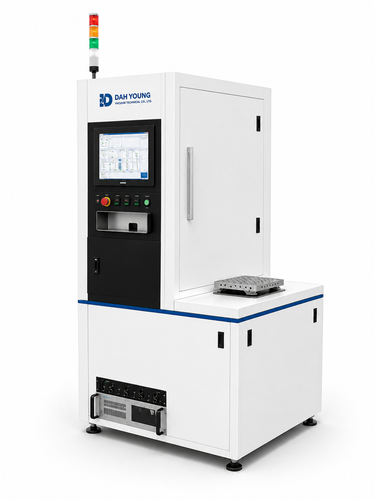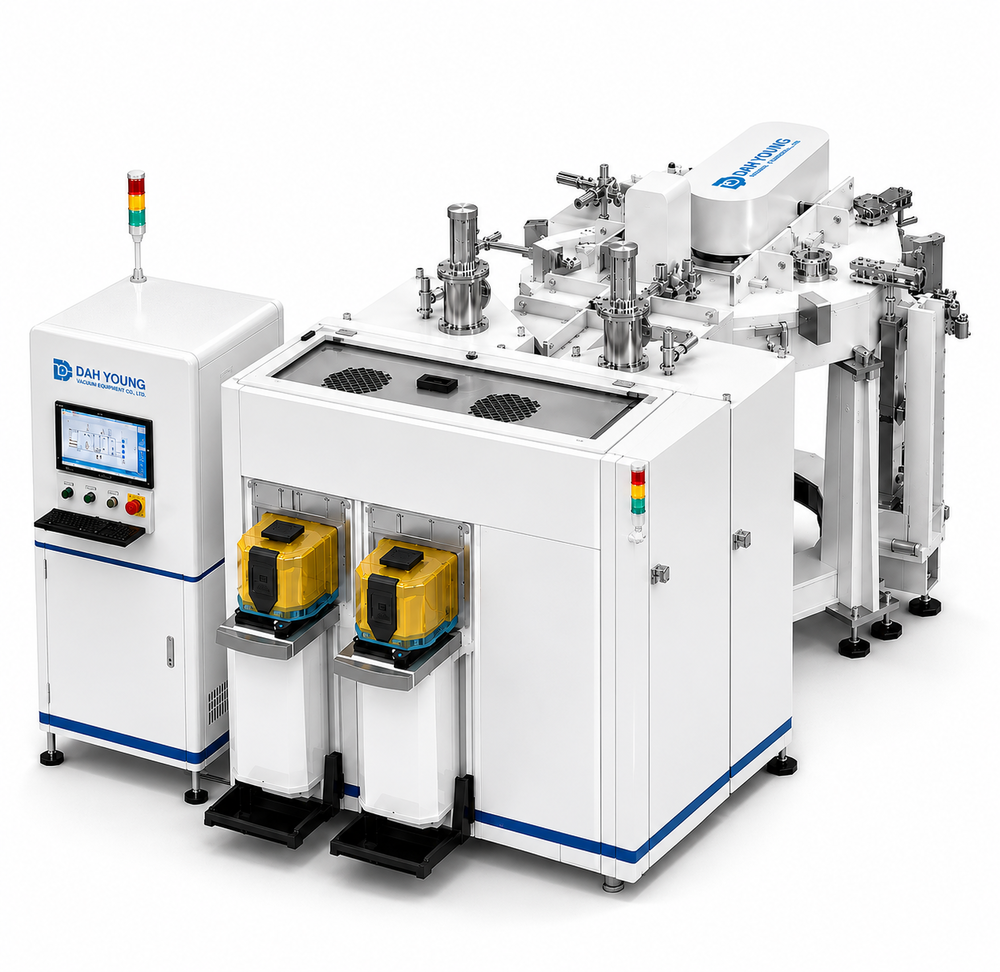
Optical Rotation Beam Ion Sputtering
ORBIS | A Horizontal Wafer-level Optical Sputter Coating System Built for Next-Generation Semiconductor Optics
Optical Rotation Beam Ion Sputtering|Horizontal Wafer-level Sputter Coating System for Semiconductor OpticsA Flagship Coating System Built for Next-Generation Semiconductor Optics Mass Production
From CMOS image sensors, VCSEL laser sources, AR/VR optical waveguides, to automotive ADAS LiDAR — contemporary semiconductor optical components share the core characteristic of chip-level miniaturization + integrated optical functionality. Optical coatings are deposited directly on wafer surfaces, imposing the most demanding requirements in the semiconductor industry on film optical quality, cleanliness, and production consistency. This is the industry's core need for a Wafer-level Sputter Coating System — and a critical link where Taiwan's semiconductor optics industry has long depended on imported equipment from Europe, the US, and Japan.
The Dah Young Vacuum ORBIS Wafer-level Optical Sputter Coating System (Optical Rotation Beam Ion Sputtering) represents Dah Young's flagship-grade equipment, built through years of in-house R&D for next-generation semiconductor optics mass production. ORBIS employs a horizontal activated reactive sputtering architecture, target-zone and plasma-zone separated design, ICP high-density plasma source, and is designed to support dual-side simultaneous coating and 100+ layer multilayer stacking — covering 4–12 inch wafer sizes with SEMI-standard handling interfaces. ORBIS is one of Dah Young's 2026 key development models, currently in Pilot phase, and we sincerely invite Taiwan's semiconductor optics industry early adopter partners to jointly participate in specification definition and mass production validation, building Taiwan's solution for semiconductor optics mass production together.
Horizontal Activated Reactive Sputtering | Target / Plasma Zone Separation as Core Architecture
Conventional reactive sputtering has long faced the core pain point of Target Poisoning — reactive gases form compound layers on target surfaces, substantially reducing sputtering efficiency and causing process instability. Leading European, US, and Japanese manufacturers have each developed different solutions, with industry-recognized technologies such as PARMS (Plasma-Assisted Reactive Magnetron-Sputtering) representing notable approaches.
ORBIS employs Dah Young's proprietary horizontal activated reactive sputtering architecture, physically separating the target zone from the reactive plasma zone at the technology principle level — the target zone admits only inert gas (Ar) for pure metal sputtering, while reactive gases (O₂, N₂) are concentrated in an independent plasma zone for efficient dissociation and activation. Substrates pass through both zones sequentially via the chamber's high-speed rotation design. Combined with inter-target alloy metal baffle design, the architecture suppresses reactive gas interference and target poisoning at the root. This approach places ORBIS alongside Bühler PARMS and Optorun Metal-mode as industry-mainstream semiconductor optics sputtering technology paradigms — providing Dah Young customers with a technically complete alternative that offers local service advantages.
ICP High-Efficiency Plasma Source | Key to Low-Absorption High-Quality Optical Films
Semiconductor optical components are extremely sensitive to optical absorption — any minor absorption directly reduces CMOS sensor quantum efficiency, VCSEL optical output power, and chip filter signal-to-noise ratio. Conventional sputtered films often suffer from elevated absorption due to incomplete oxidation reaction, requiring subsequent annealing to compensate — adding process complexity and cost.
ORBIS comes standard-equipped with an ICP (Inductively Coupled Plasma) inductively coupled plasma source — ICP delivers the industry's highest plasma density and best reaction activity, achieving complete oxidation reactions under low-energy bombardment conditions and directly depositing low-absorption, high-density, refractive-index-stable optical films. Combined with Dah Young's proprietary low-temperature process design, ORBIS suits temperature-sensitive semiconductor substrates such as InP, GaAs, SOI, and other compound semiconductors and specialty substrates — without high-temperature-induced device performance degradation. This low-temperature, low-absorption characteristic is ORBIS's core technical competitiveness for next-generation semiconductor optics needs.
Target Spec: 100+ Multilayer | Addressing Chip Filters and Hyperspectral Sensing
Semiconductor optical components increasingly rely on complex multilayer film structures — from Narrow Bandpass Filters in 3D sensing FaceID, multicolor filter arrays in hyperspectral imaging, to DWDM Edge Filters in optical communications. These applications routinely require 100+ layer structures with atomic-level thickness precision per layer.
ORBIS is designed to support 100+ layer multilayer stacking, with Pilot phase validated at 50+ layers — targeting the same technical tier as industry-leading manufacturers. Combined with the standard-equipped Dah Young Optical Monitoring System (OMS), in-situ real-time thickness feedback ensures every layer reaches its design spectrum during deposition — substantially reducing multilayer mass production failure rates. For next-generation semiconductor optical products pursuing chip-level complex optical functionality, ORBIS delivers a complete multilayer mass production solution.
4–12 Inch Full-Range Wafer Coverage | Dual-side Coating + SEMI-Standard Handling
Semiconductor optical components span diverse wafer size needs — from 4-inch small-batch trial production to 12-inch large-scale mass production. ORBIS offers two chamber designs: ORBIS-200 corresponds to 4 / 6 / 8 inch wafers, suited for medium-volume production and multi-product flexibility; ORBIS-300 employs an 8 / 12 inch shared design, addressing large-scale mass production and advanced Wafer-Level Optics (WLO) applications.
ORBIS is designed to support Dual-side Deposition — particularly suited for wafer-level optical components requiring AR coating on one side and functional coating on the other, substantially reducing process time and wafer handling steps. Wafer handling interfaces are SEMI-compatible, designed to support EFEM (Equipment Front End Module), SMIF Pod, FOUP, and other standard wafer handling solutions — integrable with customers' existing semiconductor cleanroom production lines. For customers requiring fab-grade compliance, ORBIS targets SEMI standards from the equipment design stage, ensuring future production line compatibility.
Pilot Phase | Inviting Early Adopter Partners for Joint Specification Development
ORBIS is one of Dah Young's 2026 key development flagship models, currently in Pilot development phase. Dah Young sincerely invites Taiwan's semiconductor optics industry early adopter partners — including CMOS image sensor manufacturers, VCSEL / 3D sensing module manufacturers, Wafer-Level Optics (WLO) integration manufacturers, chip filter manufacturers, AR/VR module manufacturers, and automotive ADAS sensing manufacturers — to join the ORBIS Early Adopter Program.
Early adopter partners enjoy the following value: (1) Joint Specification Definition — direct participation in ORBIS functional definition and customization options, ensuring the final production model fully meets your process requirements; (2) Priority Sampling and Validation — priority access to Pilot machines for customer-end application validation, accelerating product development timelines; (3) Deep Local Support — Dah Young engineering teams provide on-site assistance throughout process optimization, equipment tuning, and mass production transition, delivering the industry's deepest local service; (4) Strategic Partnership Positioning — jointly building Taiwan's domestic supply chain for semiconductor optics mass production, breaking free from the long-standing industry constraint of dependence on imported equipment.
Specifications
| Item | ORBIS-200 / ORBIS-300 |
|---|---|
| Product Line | Wafer-level Optical Sputter Coating System (Flagship) |
| Product Stage | 2026 Key Development Model|Pilot Phase|Early Adopter Program Open |
| Wafer Size | ORBIS-200: supports 4 / 6 / 8 inch|ORBIS-300: 8 / 12 inch shared design |
| Core Technology | Horizontal Activated Reactive Sputtering|target zone and plasma zone physically separated |
| Plasma Source | ICP (Inductively Coupled Plasma) source|high-density low-energy plasma ensures low-absorption, high-quality films |
| Target Configuration | Multi-target design|flexible planar + rotary target arrangement|inter-target alloy metal baffle for poisoning suppression |
| Dual-side Coating | Designed to support Dual-side Deposition|reduces process time and wafer handling steps |
| Multilayer Capability | Target spec: 100+ layer stacking|Pilot phase validated at 50+ layers |
| Coating Direction | Horizontal|Deposition Up |
| Particle Control | Bottom-up ion bombardment|particle generation suppressed|high-cleanliness process environment |
| Optical Monitoring | Standard-equipped Dah Young Optical Monitoring System (OMS)|in-situ real-time thickness control |
| Thickness Uniformity | Target within ± 1% (full wafer) |
| Coating Materials | Oxides (SiO₂, TiO₂, Ta₂O₅, Nb₂O₅, Al₂O₃), Nitrides, Metals, Alloys |
| Ultimate Vacuum | ≦ 5 × 10⁻⁷ Torr (high-cleanliness design) |
| Wafer Handling | Designed for SEMI-standard interfaces|EFEM, SMIF Pod, FOUP-compatible solutions |
| Operation Mode | Fully automatic IPC + PLC control|designed for 24/7 continuous mass production |
| Optional Modules | Enhanced optical monitoring, HiPIMS power, inline metrology, customized handling integration |
※ The above represents ORBIS Pilot-phase design specifications. For actual machine validation progress and final mass production specifications, customers are welcome to contact Dah Young directly for the latest status.
※ Early adopter partners may participate in joint specification definition. Dah Young provides comprehensive customization options and local engineering support.
01Horizontal Activated Reactive Sputtering | Target / Plasma Zone Separation Architecture
- Industry-Mainstream Technology: Stands alongside Bühler PARMS and Optorun Metal-mode as industry-mainstream semiconductor optics sputtering technology paradigms.
- Target Poisoning Solution: Physical separation of target zone from plasma zone + alloy metal baffle design — suppresses reactive gas target poisoning at the root.
- High Deposition Rate Stability: Pure metal sputtering + independent reaction zone activation — delivers high deposition rate and long-term process stability.
02ICP High-Efficiency Plasma Source | Low-Absorption High-Quality Films
- ICP High-Density Plasma: Inductively coupled plasma source delivers the industry's highest plasma density and reaction activity.
- Low-Absorption Film Quality: Complete oxidation reaction directly deposits low-absorption, high-density, refractive-index-stable optical films.
- Low-Temperature Process: Suits temperature-sensitive semiconductor substrates including InP, GaAs, SOI — avoiding high-temperature-induced device performance degradation.
03Target Spec: 100+ Multilayer Capability
- Multilayer Capability: Designed to support 100+ layer multilayer stacking, with Pilot phase validated at 50+ layers.
- OMS Optical Monitoring: Standard-equipped Dah Young Optical Monitoring System (OMS) — in-situ real-time thickness feedback ensures multilayer spectral precision.
- Chip Filter Mass Production: Comprehensive coverage of 3D sensing narrow bandpass filters, hyperspectral multicolor filters, DWDM edge filters, and similar applications.
044–12 Inch Full-Range Wafer Coverage + Dual-Side Coating
- Two Chamber Designs: ORBIS-200 covers 4/6/8 inch; ORBIS-300 employs 8/12 inch shared design — covering diverse mass production scales.
- Dual-Side Simultaneous Coating: Designed to support dual-side simultaneous coating, substantially reducing process time and wafer handling steps.
- WLO Wafer-Level Optics: Comprehensive support for wafer-level optical components requiring separate front / back coating.
05SEMI-Standard Handling | Semiconductor Fab-Grade Integration
- SEMI-Standard Interfaces: Designed to support EFEM, SMIF Pod, FOUP, and other semiconductor industry standard wafer handling solutions.
- High-Cleanliness Process: Bottom-up ion bombardment mode + low-particle chamber design — compliant with semiconductor cleanroom standards.
- Production Line Integration: Integrable with customers' existing semiconductor fab production lines, ensuring compatibility with current automation systems.
06Local Service + Early Adopter Program | Taiwan's Best Partner for Semiconductor Optics
- Deep Local Support: Dah Young engineering teams provide on-site assistance throughout process optimization, equipment tuning, and mass production transition — the industry's deepest local service.
- Joint Specification Definition: Early adopter partners may directly participate in ORBIS functional definition and customization options, ensuring complete alignment with your needs.
- Domestic Supply Chain: Jointly building Taiwan's domestic supply chain for semiconductor optics mass production, breaking free from long-standing dependence on imported equipment.
Combining horizontal activated reactive sputtering architecture, ICP high-efficiency plasma source, 100+ layer multilayer capability, 4–12 inch full-range wafer coverage, dual-side coating, and SEMI-standard handling, ORBIS delivers a complete solution for next-generation semiconductor optics mass production — broadly planned for application across CMOS image sensors, VCSEL / 3D sensing, wafer-level optics, chip filters, AR/VR, and ADAS sensing in core semiconductor optics markets.
01CMOS / CIS Image Sensor
CMOS image sensors are the highest-volume semiconductor optical components in contemporary consumer electronics — from smartphone cameras, automotive ADAS cameras, surveillance, to industrial vision inspection — with billions of units shipped globally per year. AR anti-reflection coatings, IR-Cut filters, and color filter arrays on CIS wafers directly determine sensor quantum efficiency, dynamic range, and signal-to-noise ratio. ORBIS's low-absorption ICP coating technology and wafer-level mass production capability comprehensively address CIS production's dual demand for optical quality + production scale.
02VCSEL / 3D Sensing
Vertical-Cavity Surface-Emitting Lasers (VCSEL) are the core light source for 3D sensing technologies — from iPhone FaceID dot projection, Time-of-Flight (ToF) distance measurement, automotive LiDAR environmental perception, to industrial robot spatial positioning. The rapid proliferation of VCSEL modules has driven explosive demand for precision optical coatings. VCSEL components require High Reflection (HR) coatings, wavelength-specific narrow bandpass filters, and ultra-low-absorption AR films — placing extremely demanding requirements on coating quality. ORBIS's low-temperature low-absorption ICP coating comprehensively addresses VCSEL production's core requirement for optical integrity.
03Wafer-Level Optics
Wafer-Level Optics is a key process for contemporary camera modules, AR/VR miniaturization, and smart wearable applications — fabricating optical lenses and functional film layers directly on wafers to achieve extreme size miniaturization and cost reduction. WLO processes require complex optical structure stacking directly on wafer surfaces, with dual-side coating capability as a core requirement. ORBIS's dual-side simultaneous coating design and 4–12 inch wafer coverage comprehensively support WLO mass production needs.
04Chip-scale Narrow Bandpass Filters
From DWDM multiplexers/demultiplexers in optical communications, fluorescence microscopy filters in bio-medical, hyperspectral imaging systems, to medical diagnostic instruments, chip-scale Narrow Bandpass Filters are core components of contemporary precision optical sensing — commonly requiring 100+ layer superlattice multilayer structures. ORBIS targets 100+ layer multilayer stacking and wafer-level mass production capability, addressing chip-scale complex filter mass production needs.
05AR/VR Optics + ADAS LiDAR
AR/VR immersive devices and automotive ADAS sensing technologies are the hottest growth applications in semiconductor optics today — AR smart eyewear waveguides, VR headset Pancake optics, and automotive LiDAR optical filters and sensing components all require wafer-level high-precision optical coating support. ORBIS's multilayer capability and dual-side coating design comprehensively address mass production needs for these next-generation immersive and sensing applications.