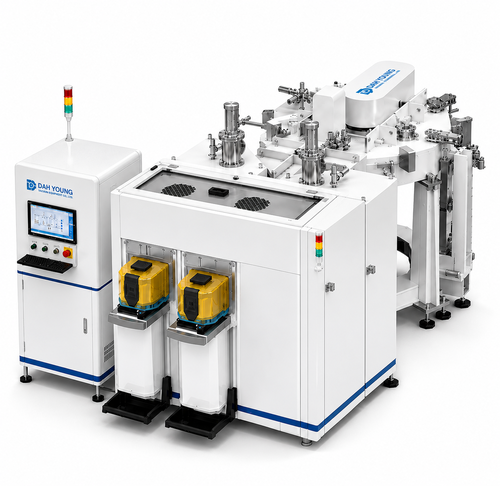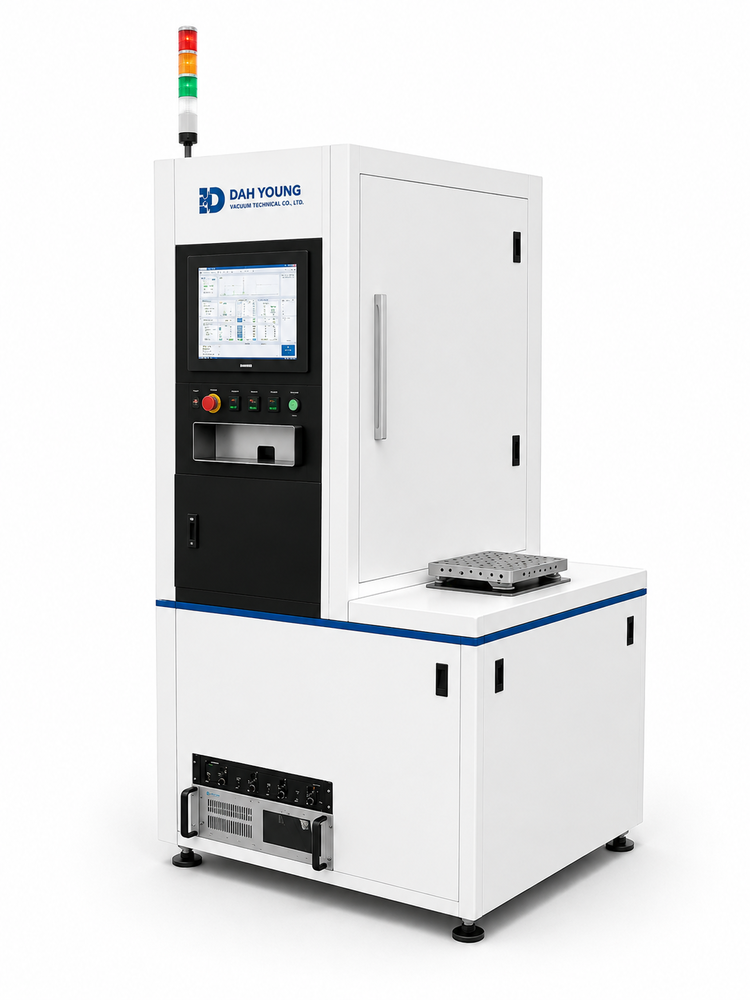
Atomic Layer Deposition System
ALD|A Precision Process Flagship for Next-Generation Optical Coating
Atomic Layer Deposition System|Plasma-Enhanced ALD for Next-Generation Optical CoatingAn Atomic-Level Coating System Built for Next-Generation Precision Optical Mass Production
From high-curvature AR coatings on smartphone camera modules, precision narrow bandpass filters in 3D sensing components, nanoscale optical structures in AR/VR waveguides, to high-cleanliness film layers in bio-medical optical instruments — the core characteristic of contemporary precision optical components has evolved from 'planar optics' to '3D microstructured optics'. As optical component functional surfaces grow ever more complex, conventional evaporation and sputtering technologies are gradually approaching their process limits. At this industry inflection point, Atomic Layer Deposition (ALD) technology has emerged as the core solution to next-generation optical coating challenges.
The Dah Young Vacuum ALD (Atomic Layer Deposition System) draws its technology from a technology transfer with the National Center for Instrumentation Research (NCIR), under the National Institutes of Applied Research (NIAR), Taiwan — grounded in years of ALD research achievements at a Taiwanese national research institute, combined with Dah Young Vacuum's years of optical coating mass production integration experience to build this next-generation flagship equipment. ALD employs a Plasma-Enhanced architecture, supports diverse precursors and SEMI-standard handling, with target spec covering wafer sizes from 4 inches and above. ALD is one of Dah Young's 2026 key development models, currently in Pilot phase, and we sincerely invite Taiwan's optics and semiconductor industry early adopter partners to jointly participate in specification definition and mass production validation.
ALD Core Advantages|Three Process Capabilities Beyond the Reach of Evaporation and Sputtering
ALD's emergence as a key technology for contemporary precision optics stems from three process capabilities beyond the reach of conventional evaporation and sputtering: First, 3D Conformal Coating — through self-limiting chemical reactions, films uniformly cover complex 3D microstructures and high-curvature surfaces. Even on the inner walls of micropores with 100:1 aspect ratios, the back surfaces of high-curvature lenses, and the 3D patterns of AR waveguides, complete and uniform coating coverage is achieved. Second, sub-nanometer thickness precision — layer-by-layer atomic deposition enables 0.1 nm-class single-layer precision control, achieving the industry's highest grade of spectral precision. Third, Pinhole-free dense film quality — the atomically packed film structure eliminates pinhole defects, providing industry-leading environmental durability and long-term reliability.
These three capabilities make ALD an indispensable process for next-generation optical applications including high-curvature smartphone lens AR coatings, 3D sensing precision filters, CMOS / VCSEL semiconductor optical sensing, and AR/VR optical waveguides. For customers pursuing ultimate optical performance and mass production yield, ALD provides a core solution that conventional processes cannot deliver.
Plasma-Enhanced Architecture|Key to Low-Temperature High-Quality Films
The core technical choice in ALD processes lies in whether plasma assistance is introduced. Conventional Thermal ALD requires high temperatures (typically 200–400°C) to complete the full chemical reaction — placing severe constraints on temperature-sensitive substrates such as plastic lenses, PC lenses, and compound semiconductors (InP / GaAs). Furthermore, thermal ALD's reaction rate is slower, and incomplete reactions may lead to elevated film absorption.
Dah Young ALD employs a Plasma-Enhanced architecture, providing high-density reactive radicals at low temperatures to achieve complete atomic layer reactions. Process temperature targets the 50–250°C range, making ALD suitable for temperature-sensitive substrates such as plastic lenses, PC lenses, and compound semiconductors. Plasma assistance also delivers superior film density, lower optical absorption, and more stable refractive index — providing industry-top film quality for precision optical applications.
NCIR Technology Transfer|Taiwan National Research Institute Endorsement
The technology foundation of Dah Young ALD comes from a technology transfer with the National Center for Instrumentation Research (NCIR). NCIR, as a core R&D institution for Taiwan's semiconductor and optics industries, has long invested in critical research on ALD process development, equipment design, and mass production validation — accumulating rich thin-film process knowledge assets. Through formal technology transfer, Dah Young has obtained the industrialization application rights for years of research achievements, while maintaining a long-term technical collaboration relationship with NCIR.
This technology endorsement carries significant meaning for customers: (1) Technical Credibility — as a national research institute, NCIR's technology has undergone rigorous academic and industrial validation; (2) Continuous Innovation Support — Dah Young's long-term collaboration with NCIR ensures ALD technology can continuously advance with industry needs; (3) Local Industrial Chain Integration — the NCIR + Dah Young collaboration model represents Taiwan's establishment of a complete 'research → development → manufacturing' end-to-end capability in the ALD field. Customers purchasing Dah Young ALD are not merely acquiring equipment, but building a long-term strategic partnership with Taiwan's ALD industrial ecosystem.
Wafer Size Coverage from 4 Inches and Above|NCIR Collaboration + SEMI-Standard Handling
Application scenarios for precision optics and semiconductor optics are diverse — from small-batch smartphone lens sampling in consumer electronics, to medium-volume camera module mass production, to wafer-level semiconductor optical mass production. Substrate sizes span an enormous range. Dah Young ALD's specification targets cover wafer sizes from 4 inches and above and a variety of optical components.
Handling interfaces are SEMI semiconductor industry-compatible, designed to support EFEM (Equipment Front End Module), SMIF Pod, and other diverse wafer handling solutions — integrable with customers' existing semiconductor cleanroom production lines. This design philosophy aligns with the Dah Young ORBIS Wafer-level Optical Sputter Coating System, providing customers with a complete 'ALD + ORBIS dual flagship' semiconductor optics mass production solution.
Pilot Phase|Inviting Early Adopter Partners from the Optics and Semiconductor Industries
ALD is one of Dah Young's 2026 key development flagship models, currently in Pilot development phase. Dah Young sincerely invites Taiwan's optics and semiconductor industry early adopter partners — including smartphone camera module manufacturers, 3D sensing module manufacturers, CMOS image sensor manufacturers, MicroLED display and epitaxy manufacturers, AR/VR optical integration manufacturers, bio-medical optical instrument manufacturers, and precision optical filter manufacturers — to join the ALD Early Adopter Program.
Early adopter partners enjoy the following value: (1) Joint Specification Definition — direct participation in ALD functional definition and customization options, ensuring the final production model fully meets your process requirements; (2) Priority Sampling and Validation — priority access to Pilot machines for customer-end application validation, accelerating product development timelines; (3) Deep Local Support — Dah Young and NCIR engineering teams provide full assistance throughout process optimization, equipment tuning, and mass production transition — delivering the industry's deepest 'research institute + equipment maker + customer' tripartite collaboration model; (4) Strategic Partnership Positioning — jointly building Taiwan's domestic supply chain for ALD optical mass production, breaking free from the long-standing industry constraint of dependence on European and Japanese imported equipment.
Specifications
| Item | ALD (Atomic Layer Deposition System) |
|---|---|
| Product Line | Atomic Layer Deposition System (Independent Flagship Platform) |
| Product Stage | 2026 Key Development Model|Pilot Phase|Early Adopter Program Open |
| Technology Endorsement | Technology transferred from the National Center for Instrumentation Research (NCIR)|grounded in years of ALD research at a national research institute |
| Core Technology | Plasma-Enhanced ALD|layer-by-layer atomic-level deposition|Self-limiting Reaction |
| Plasma Source | Low-temperature high-reactivity plasma source|suited for temperature-sensitive substrates |
| Precursor Support | TMA (Al₂O₃), 3DMAS (SiO₂), TiCl₄ (TiO₂), HfCl₄ (HfO₂), and other diverse precursors |
| Coating Materials | Al₂O₃, SiO₂, TiO₂, Ta₂O₅, HfO₂, and other oxides and nitrides |
| 3D Conformal Capability | Industry-leading 3D Conformal Coating capability|full coverage on 3D microstructures and high-curvature surfaces |
| Thickness Control | Sub-nanometer thickness precision|single-layer precision down to 0.1 nm-class |
| Film Quality | Pinhole-free dense film|low-stress (Stress-controlled)|high uniformity |
| Wafer Size Coverage | Target spec: 4 / 6 / 8 inch wafer sizes and optical components|compatible with both wafers and large-substrate optics |
| Process Temperature | Target temperature range 50–250°C|low-temperature operation suits temperature-sensitive substrates such as plastic / PC lenses |
| Wafer Handling | Designed to support SEMI-standard interfaces|EFEM, SMIF Pod-compatible solutions |
| Operation Mode | Fully automatic IPC + PLC control|designed for 24/7 continuous mass production |
| Optional Modules | In-situ optical monitoring, multi-precursor switching, customized handling integration, specialty substrate fixtures |
※ The above represents ALD Pilot-phase design specifications. For actual machine validation progress and final mass production specifications, customers are welcome to contact Dah Young directly for the latest status.
※ Early adopter partners may participate in joint specification definition. Dah Young and NCIR provide comprehensive customization options and technical support.
01NCIR Technology Transfer | Taiwan National Research Institute Endorsement
- NCIR Technology Transfer Background: Technology drawn from years of ALD R&D achievements at the National Center for Instrumentation Research (NCIR), through formal technology transfer.
- Technical Credibility: Rigorously validated through academic and industrial verification — providing customers with the most credible technology endorsement.
- Long-Term Technical Collaboration: Dah Young maintains a long-term technical collaboration with NCIR, ensuring ALD technology can continuously advance with industry needs.
023D Conformal Coating | Beyond the Reach of Evaporation and Sputtering
- 3D Conformal Coverage: Self-limiting chemical reaction characteristics — films uniformly cover complex 3D microstructures and high-curvature surfaces.
- High Aspect Ratio Structures: Addresses 100:1 aspect ratio micropore inner walls, high-curvature lens back surfaces, AR waveguide 3D patterns, and similar structures.
- Key to Next-Generation Optics: Indispensable process for high-curvature smartphone lens dual-side AR, 3D sensing precision filters, AR/VR waveguides, and similar applications.
03Sub-Nanometer Thickness Precision | Layer-by-Layer Atomic Deposition
- 0.1 nm-Class Precision: Layer-by-layer atomic deposition enables single-layer precision control down to 0.1 nm-class.
- Spectral Precision: Industry's highest grade of spectral precision — achieving high-end optical requirements such as ultra-low reflectance below 0.1%.
- Pinhole-Free Dense Films: Atomically packed film structure eliminates pinhole defects, providing industry-leading environmental durability.
04Plasma-Enhanced Architecture | Low-Temperature High-Quality
- High-Efficiency Plasma: Plasma source provides high-density reactive radicals to achieve complete atomic layer reactions.
- Low-Temperature Process: Target temperature range 50–250°C, suitable for temperature-sensitive substrates including plastic lenses, PC lenses, and compound semiconductors.
- High-Quality Films: Plasma assistance delivers superior film density, lower optical absorption, and more stable refractive index.
05Diverse Substrate Coverage + Dual-Side Coating + SEMI Integration
- 4-Inch and Above Coverage: Specification targets cover diverse wafer sizes from 4 inches and above and a variety of optical components.
- Dual-Side Simultaneous Coating: Designed to support dual-side simultaneous coating, substantially reducing process time and substrate handling steps.
- SEMI-Standard Handling: Designed to support EFEM, SMIF Pod, and other semiconductor industry standard wafer handling solutions.
06Local Service + Early Adopter Program
- Tripartite Collaboration: Dah Young engineering teams + NCIR technical experts + customer-end application validation — an industry-rare deep tripartite collaboration.
- Joint Specification Definition: Early adopter partners may directly participate in ALD functional definition and customization options.
- Domestic Supply Chain: Jointly building Taiwan's domestic supply chain for ALD optical mass production, breaking free from long-standing dependence on European and Japanese imported equipment.
Combining NCIR technology endorsement, Plasma-Enhanced architecture, 3D conformal coating capability, sub-nanometer thickness precision, and SEMI-standard handling, ALD delivers a complete solution for next-generation precision optical mass production — broadly planned for application across semiconductor optical sensing, MicroLED and next-generation displays, smartphone and consumer optics, AR/VR Photonic Integration, and bio-medical precision optics in core growth markets.
01Semiconductor Optical Sensing
Semiconductor optical sensing is contemporary ALD's most critical growth market — from smartphone FaceID 3D sensing modules, CMOS image sensor precision filters, hyperspectral imaging multicolor filter arrays, to automotive LiDAR narrow bandpass filters. These applications universally demand ultimate optical precision and semiconductor fab-grade process cleanliness. ALD's sub-nanometer thickness precision, Pinhole-free dense film quality, and SEMI-standard integration capability comprehensively address the core needs of these applications. Complementing the Dah Young ORBIS Wafer-level Optical Sputter Coating System, ALD provides a complete semiconductor optics mass production solution.
02MicroLED & Next-Generation Display
MicroLED is the most-watched next-generation display technology of 2025–2030 — from Apple Vision Pro, large-format MicroLED TVs, automotive MicroLED dashboards, AR eyewear micro-displays, to next-generation structures combining µLED with QD (Quantum Dot) color conversion. MicroLED and its derivative display technologies are comprehensively challenging OLED's established market position. However, MicroLED's process bottleneck lies in the core pain point: the smaller the die, the more sharply luminous efficiency drops. As LEDs scale from millimeter to micrometer dimensions, the proportion of die sidewall damage increases sharply, causing massive non-radiative recombination at sidewalls and collapsing EQE as dies shrink. ALD's 3D conformal coating capability is the indispensable process to solve this pain point — through self-limiting reactions, Al₂O₃ passivation layers are uniformly deposited on micrometer-scale die sidewalls, repairing sidewall defects, suppressing non-radiative recombination, and directly improving MicroLED luminous efficiency and mass production yield. Taiwan is a global MicroLED industry hub, with a complete domestic value chain from upstream LED epitaxy, mass transfer, panel integration, to driver IC. Dah Young ALD comprehensively addresses Taiwan's MicroLED industry's core coating needs.
03Smartphone Lens & Consumer Optics
The evolution direction of smartphone camera modules is 'high curvature + dual-side AR + ghost flare elimination' — as smartphone cameras advance toward greater light intake, wider field of view, and thinner module designs, lens curvature continues to increase, making complete dual-side AR coating coverage progressively more difficult for conventional evaporation and sputtering. ALD's 3D conformal coating capability comprehensively solves the core challenge of dual-side AR on high-curvature lenses, achieving ultra-low reflectance below 0.1% in the visible region while eliminating ghost / flare phenomena — providing industry-top optical quality for consumer electronics lenses.
04AR/VR Photonic Integration
Core optical components of AR/VR immersive devices — Waveguides, Diffractive Optical Elements (DOE), Metasurfaces, Pancake miniaturized optics — represent the most challenging application domain in contemporary precision optics. These components are characterized by nanoscale 3D microstructures + demanding optical precision + production consistency — entirely beyond conventional evaporation / sputtering process capabilities. ALD's sub-nanometer thickness precision and 3D conformal coating capability are the indispensable process for solving these next-generation optical challenges.
05Bio-Optics & Precision Instruments
Bio-medical optical instruments (microscopes, endoscopes, fluorescence quantification, spectroscopy) and precision scientific instruments demand 'ultimate cleanliness + low stress + long-term stability' in optical coatings — any minor pinhole or stress defect can cause noise in microscopic imaging or measurement errors. ALD's Pinhole-free dense film quality and low-stress (Stress-controlled) characteristics provide industry-top optical coating reliability. Low-temperature processing also addresses bio-medical applications' core requirement of not altering substrate properties.