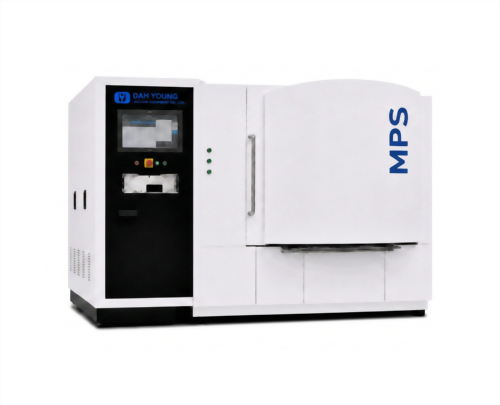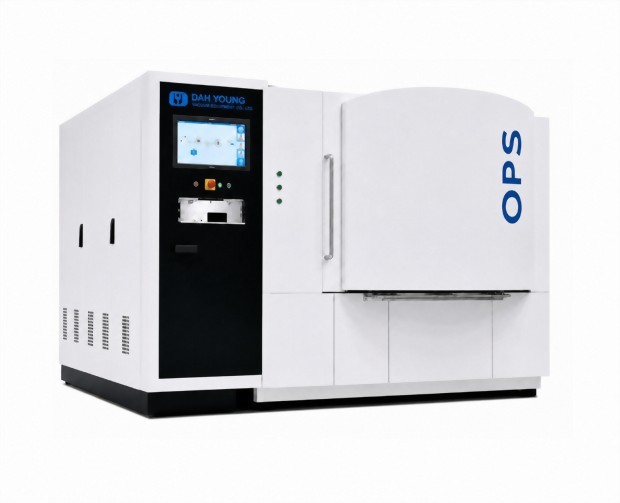
Optical Precision Sputter
OPS|A High-End Sputtering Solution Built for Precision Optical Components
Optical Precision Sputter|High-Density Multilayer Sputtering for Precision OpticsA High-End Sputtering Platform Built for Precision Optical Components
From automotive ADAS lenses, surveillance lenses and 3D sensing narrow bandpass filters, to bio-medical fluorescence filters and the Pancake lenses and waveguides of AR/VR — modern optical components push coating precision, uniformity and multilayer capability to their limits. Under demanding operating conditions, conventionally evaporated films frequently suffer adhesion degradation, spectral drift and surface scratching, directly compromising the long-term reliability of the optical system.
The Dah Young Vacuum OPS (Optical Precision Sputter) is a high-end optical coating system built on Dah Young's proprietary ARMS high-precision sputtering platform. The OPS integrates a separated activated reactive sputtering architecture, dual ICP inductively coupled plasma sources, multilayer stacking capability, and Dah Young's proprietary ultra-hard coating technology — delivering industry-leading sputtering solutions for automotive optics, precision filters and immersive display applications.
Separated Activated Reactive Sputtering|Film Density Evaporation Cannot Reach
Compared with conventional evaporation, sputtering's principal advantage is that high-energy particles bombard the substrate with far greater energy, packing film atoms tightly into a dense structure with markedly improved adhesion. The OPS employs Dah Young's proprietary separated Activated Reactive Magnetron Sputtering architecture, effectively isolating the metal sputtering zone from the reactive plasma zone and addressing conventional reactive sputtering's target poisoning problem at the root.
This separated architecture preserves sputtering's high deposition rate and long-run stability while enabling precise thickness control through rapid alternating stacking of metal and oxide layers. Films deposited by the OPS pass rigorous automotive-grade reliability testing (damp heat, thermal shock, salt spray, mechanical vibration), suiting high-durability optical applications exposed long-term to outdoor and industrial environments.
Multilayer Capability|Precision Stacking of 100+ Layers Without Compromise
High-end film systems such as narrow bandpass, edge and dual-band filters routinely require precise stacking of 100+ pairs of high / low refractive index layers. Thickness errors in any single layer are amplified through the stack, directly affecting the final component's center wavelength, full-width-at-half-maximum (FWHM) and pass-band flatness.
The OPS combines the high-deposition-rate advantage of separated activated reactive sputtering with a high-speed rotating chamber design, achieving rapid alternating stacking of metal and oxide layers and completing 100+ layer multilayer structures. Single-layer thickness precision reaches ± 0.5 nm and center wavelength deviation is controlled within ± 0.5%, meeting the highest grade required by 3D sensing, bio-medical spectroscopy and AR/VR optical path design.
Dual ICP Inductively Coupled Plasma|High Dissociation, Low Particle, Long-Term Stability
The OPS comes standard-equipped with two Dah Young in-house ICP (Inductively Coupled Plasma) sources, delivering industry-leading gas dissociation and reaction efficiency. The high-density activated reactive gas generated by the ICP reacts efficiently with metal ions to form dense oxide / nitride films, ensuring refractive index accuracy and long-term spectral stability. The dual-source configuration secures reaction uniformity across large and 3D-curved substrates, improving film consistency throughout the multilayer stack.
The low-particle process design, combined with precision chamber flow control and optimized gas distribution, substantially reduces particle contamination on component surfaces. For applications such as 3D sensing modules — where a single filter affects entire sensor yield — the OPS delivers industry-leading cleanliness and yield performance.
Dah Young Proprietary Ultra-Hard Coating|Mohs Hardness 7 on Glass Optics
The outermost coating of an optical component faces friction, dust and scratching directly — automotive lenses struck by road debris, surveillance lenses exposed outdoors long-term, industrial inspection lenses in frequent contact with coolant and particulates. Conventional optical films often cannot meet the long-term durability such applications demand.
The OPS integrates Dah Young's latest proprietary ultra-hard coating technology, process-optimized for glass optical substrates, depositing films reaching Mohs hardness 7 (equivalent to natural quartz crystal grade) and passing rigorous 10,000-cycle steel wool abrasion testing. This breakthrough hardness specification places OPS-coated components at the industry forefront in scratch and abrasion resistance, providing powerful differentiation for automotive, security and industrial applications where long-term reliability is paramount.
3D-Curved & Complex Geometry Coating|Matched to the Geometry of Optical Components
Optical components are commonly spherical, aspherical or freeform, and often carry micro-structures — the folded light paths of Pancake lenses, the concentric micro-structures of Fresnel lenses, the grating micro-structures of waveguides. Each pushes step coverage to its limits, and the directional deposition characteristic of conventional evaporation struggles to coat such surfaces uniformly.
The OPS combines the high particle energy and excellent step coverage inherent to sputtering with Dah Young's single-axis revolution fixture design, depositing uniform, stable and repeatable optical films on flat, spherical, aspherical and 3D convex substrates. Thickness uniformity is held within ± 0.5% on flat substrates and within ± 1% even on 3D-curved geometries, securing imaging quality and production yield.
Flexible Target Configuration|Covering Industry-Wide Film System Needs
The OPS employs Dah Young's proprietary multi-target design, with flexible chamber configuration of single or dual targets and pre-mixing of process gases to enhance dissociation activation rate — further breaking through the traditional limits of reactive sputtering. Customers can flexibly adjust target configuration and gas formulations per film system design, achieving an optimal three-way balance among high deposition rate, high film quality and high stability.
Specifications
| Item | OPS-1650 |
|---|---|
| Product Line | Sputter Series- Optical Precision Sputter |
| Chamber Specification | Ø1650 mm process chamber|1650 platform |
| Substrate Material |
Glass optical lenses (BK7, Fused Silica, sapphire, optical glass grades) Optical filter substrates (B270, Schott series) High-refractive-index glass (Schott, Hoya series), resin optical substrates Plastic lenses supported via optional adaptation |
| Coating Technology |
Activated Reactive Magnetron Sputtering (ARMS-based) Metal and reaction zones separated to overcome target poisoning |
| Sputter System |
4 sputter systems as standard Flexibly configurable single / dual targets adapted to various film systems |
| Plasma Source |
2 sets of Dah Young in-house ICP (Inductively Coupled Plasma) source as standard Dual plasma sources improve reaction uniformity and film consistency on large and 3D-curved substrates |
| Fixture Design |
Single-axis revolution fixture Customizable to substrate geometry: spherical / aspherical / flat / 3D convex |
| Layer Stacking Capability | 100+ layer multilayer structures for complex optical designs |
| Thickness Precision |
± 0.5 nm (single layer) ± 0.5% center wavelength precision (multilayer) |
| Thickness Uniformity |
Within ± 0.5% (flat substrates, full load) Within ± 1% (3D-curved substrates, full load) |
| Ultra-Hard Coating |
Dah Young proprietary ultra-hard coating process (glass substrates) Mohs hardness up to 7|steel wool 10,000-cycle abrasion test |
| Film Properties | High-density sputtered films — superior adhesion, abrasion resistance and environmental stability versus evaporation |
| Coating Materials |
Oxides (SiO₂, TiO₂, Ta₂O₅, Nb₂O₅, HfO₂, Al₂O₃) Metals (Al, Ag, Cr, Ti), Nitrides (Si₃N₄) Low-absorption high / low refractive-index pairs |
| Ultimate Vacuum |
LL Chamber ≦ 8 × 10⁻³ Torr PR Chamber ≦ 5 × 10⁻⁶ Torr |
| Operation Mode | IPC fully automatic / manual mode|designed for long-run continuous processing |
| Optional Modules | AF module / low-temperature process module / advanced plasma source / custom fixtures |
※ The above represents standard configuration. Actual specifications can be customized to customer application requirements.
01Separated Activated Reactive Sputtering Architecture
- Target poisoning solved: Metal sputtering zone and reactive plasma zone are effectively isolated, addressing conventional reactive sputtering's target poisoning problem at the root.
- High rate, long operation: High-speed rotating chamber design balances high deposition rate with long-run stability, suitable for 24/7 volume production.
- High film density: High-energy sputtered particles pack densely on the substrate surface, delivering film density far superior to conventional evaporation.
02Multilayer Capability & High-Precision Thickness Control
- 100+ layer stacking: Capable of completing 100+ layer multilayer structures, meeting the most complex filter and optical film system designs.
- Single layer ± 0.5 nm: Single-layer thickness precision controlled within ± 0.5 nm, meeting optical communications and bio-medical requirements.
- Center wavelength ± 0.5%: Multilayer center wavelength deviation controlled within ± 0.5%, ensuring optical path accuracy.
03Dual ICP High-Density Plasma Source
- Dual plasma as standard: Two Dah Young in-house ICP sources come standard, ensuring reaction uniformity and film consistency across large substrates.
- Stable optical performance: Ensures precise refractive index and long-term spectral stability of oxide / nitride films.
- High dissociation efficiency: Dah Young in-house ICP delivers industry-leading plasma density and gas dissociation efficiency, densifying multilayer structures.
04Dah Young Proprietary Ultra-Hard Coating|Mohs Hardness 7 on Glass Optics
- Mohs hardness 7: Film hardness on glass substrates reaches Mohs 7, equivalent to natural quartz crystal grade.
- Steel wool 10,000 cycles: Passes 10,000-cycle steel wool abrasion testing with no significant degradation of film integrity.
- Scratch & damage resistance: Suitable for automotive, outdoor and industrial applications with high abrasion risk, substantially extending component service life.
05Automotive-Grade Environmental Durability
- Damp heat testing: Passes 85°C / 85% RH 500-hour testing, suitable for automotive and outdoor applications.
- Thermal shock testing: Passes -40°C to +85°C thermal shock cycling, meeting automotive industry reliability standards.
- Salt spray resistance: Passes salt spray testing, suitable for coastal, outdoor and industrial environments.
06Uniform Coating on 3D-Curved & Complex Geometries
- High-energy sputtering: High particle energy and excellent step coverage suit non-planar and micro-structured components.
- Revolution-type fixture: Single-axis revolution fixture design ensures batch production uniformity across varied curvatures.
- Uniformity ± 0.5% / ± 1%: Full-load uniformity within ± 0.5% on flat substrates and ± 1% on 3D-curved substrates.
07Flexible Target Configuration & Low-Particle Process
- Multi-target layout: The chamber supports multi-target configuration, flexibly arranged as single / dual targets per film system needs.
- Gas pre-mixing: Supports process gas pre-mixing and activation tuning, further breaking through reactive sputtering limits.
- Low-particle architecture: Separated architecture and optimized flow design suppress particle generation, ensuring batch-to-batch yield consistency.
Combining separated activated reactive sputtering, dual ICP high-density plasma, 100+ layer multilayer capability, proprietary ultra-hard coating and uniform 3D-curved deposition, the OPS delivers industry-leading sputtering solutions across high-precision optical components — broadly deployed in automotive optics, surveillance, 3D sensing, immersive displays, bio-medical spectroscopy, aerospace and consumer electronics.
01Automotive Optics
Automotive optical lenses (ADAS, autonomous driving, in-cabin monitoring) are the fastest-growing optical application in the automotive industry, requiring rigorous automotive-grade reliability testing (-40°C to +85°C, damp heat, salt spray, mechanical vibration). The OPS's high-density sputtered film quality and environmental durability make it a dependable choice for the automotive optical supply chain.
02Surveillance & Machine Vision
Surveillance lenses must sustain optical quality under 24/7 operation, while Industry 4.0 applications — automated optical inspection (AOI), machine vision, and semiconductor wafer inspection — demand exceptional resolution, spectral purity and long-term stability. The OPS's abrasion-resistant film quality and multilayer capability serve both.
033D Sensing & LiDAR
3D sensing modules (FaceID, ToF, structured light) and automotive LiDAR require high-precision narrow bandpass filters (940 nm, 1380 nm, 1550 nm) to isolate specific laser wavelengths and reject ambient light interference. The OPS's multilayer capability and precision thickness control make it key equipment for 3D sensing mass production.
04AR/VR/MR Immersive Optics
The folded light paths of Pancake lenses, the grating micro-structures of waveguides, and the concentric micro-structures of Fresnel lenses each push step coverage to its limits. The OPS combines the high particle energy of sputtering with 3D-curved fixture design, holding uniformity within ± 1% on non-planar and micro-structured substrates.
05Bio-medical & Scientific Instruments
High-sensitivity bio-medical equipment such as fluorescence microscopy, flow cytometry, real-time PCR detection and DNA sequencers demand exceptional spectral purity, blocking depth (OD > 6) and signal-to-noise ratio; scientific spectroscopic instruments demand color accuracy and spectral flatness. The OPS's high-precision multilayer process and low-particle cleanliness meet medical-diagnostic-grade requirements.
06Aerospace & Optical Communication
LEO satellite communications, space telescopes, ground observation systems and satellite sensors demand top-tier specialty spectral designs, extreme environmental tolerance and long-term stability. The OPS's high-density sputtered film quality and multilayer precision place it among the few systems capable of meeting these extreme requirements.
07Premium Consumer Electronics & Wearable Sensing
Premium smartphone lenses and sapphire lens protectors face rising demands for hardness and scratch resistance, while wearable ambient light sensing (ALS), heart rate / blood oxygen sensing (PPG) and near-infrared spectroscopy require high-precision narrow bandpass filters for signal accuracy. The OPS's proprietary ultra-hard coating and multilayer capability address both.